
If your app takes more than a few seconds to load, users won’t wait.
They’ll leave.
That’s how digital products are judged today. Speed, experience, and reliability matter more than ever, and technology is moving too fast for outdated systems to survive.
This is exactly why full-stack development is changing as we enter 2026. The focus is no longer just on an app that functions. The focus is on a fast, secure, and scalable app that can be “the next.”
Now, let’s break down the top full-stack development trends to watch in 2026 and see what really matters.
What is Full-Stack Development?
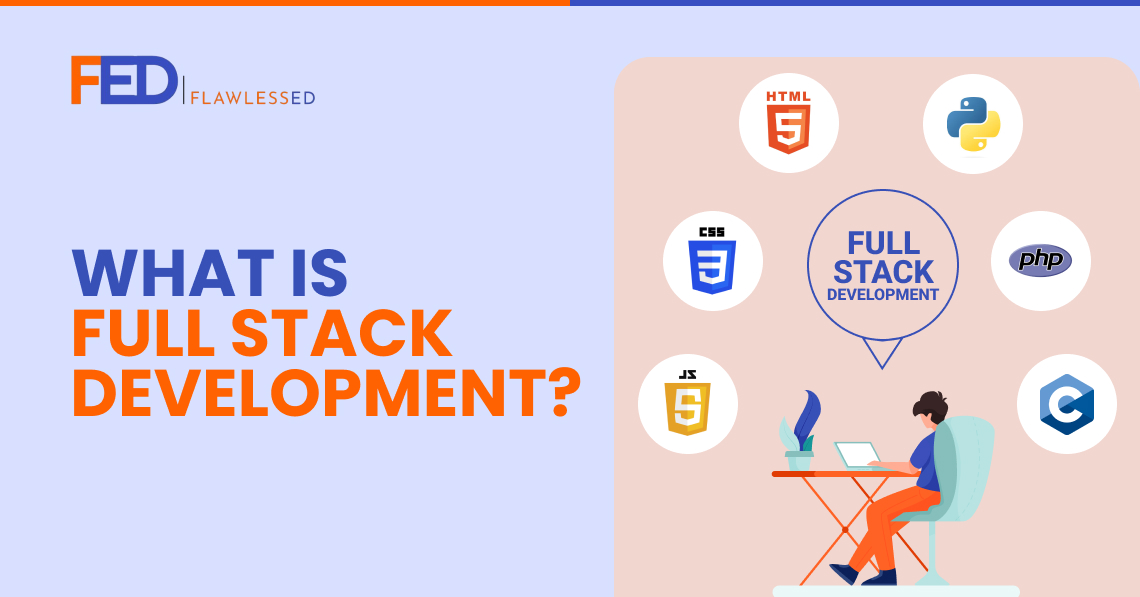
The front end is what users experience- the visuals, structure, interactive elements, and the overall experience. On the other hand, the back end consists of the server, database, logic, and components that every user interaction depends on. If one side is not good enough, the whole system will be affected.
Full-stack development unites both sides. It is centered around creating the whole app as a single entity that communicates internally, instead of the front end and back end being two halves that hardly talk to each other.
Full-stack development is a win-win strategy for companies as it paves the way to better performance, less expenditure, and staying agile enough to accommodate changes in technology and user expectations.
Full-Stack Development Trends to Watch in 2026
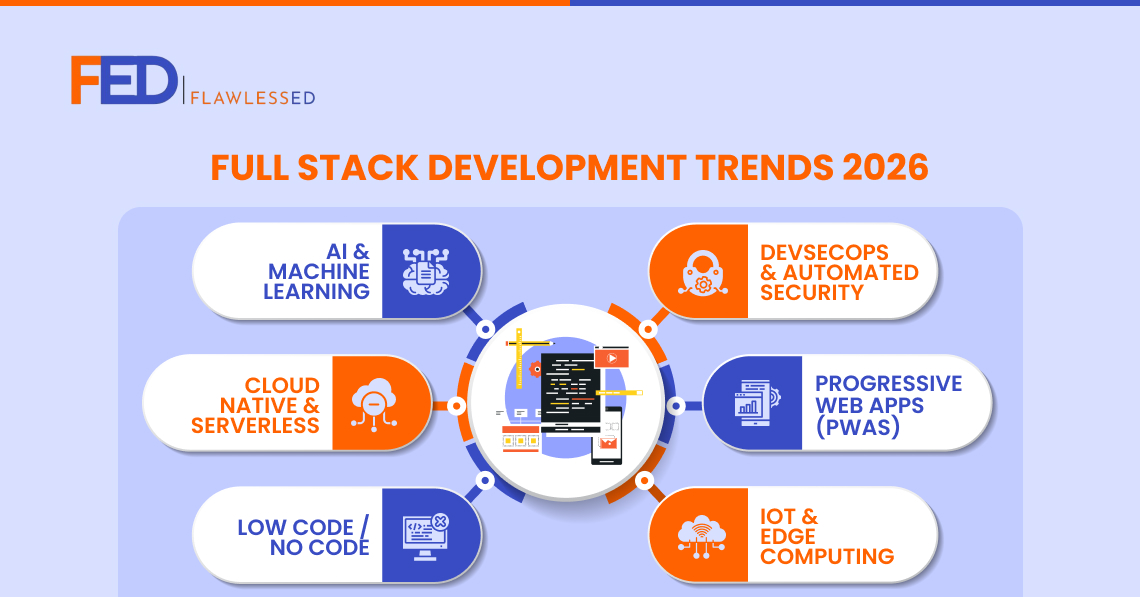
1. AI & Machine Learning
AI is no longer an add-on in full-stack development; it’s becoming a core feature. Applications are getting smarter with personalized experiences, predictive insights, and intelligent automation.
On the development side, AI is helping teams write cleaner code, test faster, and fix issues early. This means better-performing apps and quicker delivery without compromising quality. In 2026, full-stack solutions that don’t use AI will feel outdated.
2. Cloud-Native & Serverless
More applications are being built directly for the cloud instead of being moved there later. Cloud-native and serverless environments provide apps with the capability of auto scaling in direct response to user demand.
Developers are freed from server management tasks that not only save them time but also minimize the costs. Businesses can enjoy a rapid go-to-market along with the capability of holding without any glitches. It’s all about flexibility and growth without limits.
3. Low-Code / No-Code
Low-code and no-code are revolutionary tools that speed up the entire process of application creation, as well as refreshing the apps. They allow for the creation of dashboards, workflows, and internal tools without having to code from scratch.
AI doesn’t replace full-stack developers; it helps them move faster and focus on complex logic. Businesses can test ideas quickly and make changes without long development cycles.
4. DevSecOps & Automated Security
Nowadays, development teams and security teams work together. It is a continuous process from coding the application to automatically deploying it. Automated testing is part of the process, and it is run before the application is released.
This kind of security work helps to minimize issues, stay in line with regulations, and get customers’ trust. Security isn’t a bonus anymore. It is the baseline.
5. Progressive Web Apps (PWAs)
With PWAs, you get browser-based experiences that feel like apps. They are super quick, can even work when you are offline, and work well on any wave of devices. They are winning businesses over because one code set is able to support both web and mobile.
People love them because they are accessible and don’t take up device storage. The trend of using PWAs is going to continue in 2026.
6. IoT & Edge Computing
With more smart devices in use, full-stack development is expanding beyond traditional apps. IoT and edge computing provide the possibility of processing data right at the source. This makes communication faster and the user experience better.
Healthcare, logistics, manufacturing, and smart systems are industries where this technology has great potential for utilization. Faster data means faster decisions and better experiences.
Benefits of Full-Stack Solutions
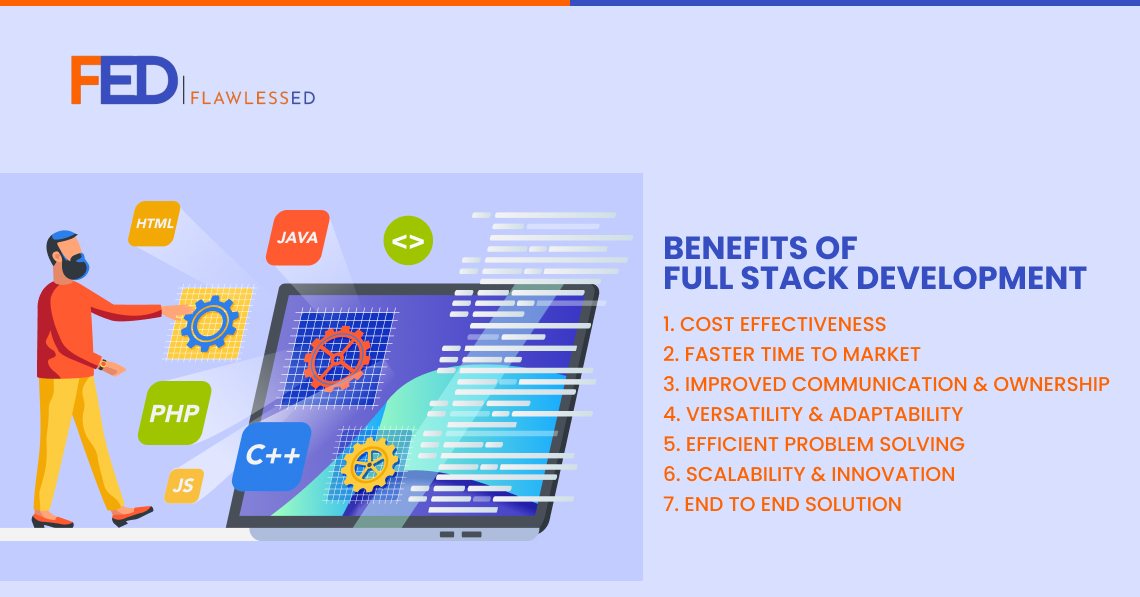
Cost-Effectiveness
Full-stack solutions help in reducing the total cost of software development by maintaining a single, integrated workflow. The unified follow-up style reduces coordination efforts and overhead instead of managing separate teams for front-end and back-end. Fewer handoffs mean fewer mistakes and rework. Over time, this results in better use of the budget without sacrificing quality.
Faster Time-to-Market
When one team understands the entire system, things move faster. Decisions are made quickly, development cycles are shorter, and updates roll out without delays. This speed is crucial when markets change or new ideas need to be tested fast.
Improved Communication & Ownership
Through full-stack development, each person gets to know the product inside and out. This clears up any miscommunication or the “not my part” problem. Teams are more committed as they see the overall effect of their work. The result is better collaboration and a more reliable product.
Versatility & Adaptability
Full-stack solutions are easier to adapt when business needs change. Whether it’s adding new features, integrating tools, or shifting platforms, changes can be handled smoothly. This flexibility helps businesses respond quickly to user feedback and market trends.
Efficient Problem-Solving
Issues are easier to identify and fix when the entire system is well understood. Full-stack teams can trace problems across the front end, back end, and database without delays. This reduces downtime and improves performance. Faster problem-solving leads to better user experience and trust.
Scalability & Innovation
Full-stack solutions are built with growth in mind. They provide systems that can easily grow in the number of users as well as adapt to different needs that enter the market. Businesses can innovate without worrying about breaking existing features. This makes long-term growth smoother and more predictable.
End-to-End Solution
Full-stack development is about delivering a product that is a complete solution. The stages from planning, coding, deploying the product, and maintaining are all seen as one connected system; everything runs smoothly. This is how the company secures consistency, stability, and long-term value. For businesses, it means fewer gaps and better results.
Ready to Use Full-Stack Development Trends?
Knowing the trends is useful, but the main thing is to understand how to use them in real-life projects.
In 2026, full-stack development is about understanding how modern technologies fit together and how they solve real problems. It doesn’t matter if it’s AI-driven components, cloud systems, or scalable infrastructures; the focus is on creating products that are efficient and adaptable to future needs.
At Flawless-Ed, education isn’t just about theory. The focus is on practical, industry-ready skills that help learners understand how modern full-stack applications are actually built and used in real-world scenarios. From current technologies to hands-on experience, the learning approach prepares you for what the industry expects next.
See you in the next blog with more updates on tech, skills, and learning paths you can explore at Flawless-Ed.
FAQs
Q- Is full-stack developer in demand in 2026?
A- Yes, full-stack developers will remain in high demand in 2026. Businesses prefer professionals who can handle both front-end and back-end development and adapt quickly to new technologies. Their ability to build complete, scalable solutions makes them valuable across industries.
Q- Which full-stack developer is in demand in the future?
A- Developers skilled in modern frameworks, cloud platforms, APIs, and security practices will be in the highest demand. Those who understand AI integration, DevSecOps, and scalable architectures will stand out. Versatility and real-world problem-solving skills matter most.
Q- Will AI replace full-stack developers?
A- No, AI will not replace full-stack developers. Instead, it will support them by automating repetitive tasks and speeding up development. Human thinking, decision-making, and system design will still be essential.
Q- What are the tools required for full-stack development?
A- Common tools include front-end frameworks, back-end technologies, databases, version control systems, and cloud platforms. Developers also use testing, deployment, and security tools to build and maintain reliable applications. The exact stack depends on the project.
Q- What are full-stack development services?
A- Full-stack development services cover everything from UI design and front-end development to back-end logic, database management, and deployment. They also include maintenance, upgrades, integrations, and performance optimization. It’s a complete end-to-end solution for digital products.