
Currently, data science occupations rank among the world’s fastest-expanding markets, and the demand is only increasing in 2026.
And the question is: how can you become a data scientist?
You might be thinking – Do I need a degree? Do I need to be good at math? Where do I even start?
And genuinely, these questions are what give most beginners a headache.
But you don’t have to figure everything at once. If you follow the right steps and focus on the right skills, becoming a data scientist is completely possible, even if you’re starting from scratch.
In this blog, our goal is to provide you with a clear and simple plan through which you will be able to understand the steps necessary for securing your first data science role in the year 2026.
What Is Data Science And A Data Scientist?
Data science is about using data to understand things and make better decisions. Every time a company wants to know what customers like, what might happen next, or how to improve something, they use data.
The one who takes care of data is called a data scientist. So, it is you who is responsible for gathering data, putting it in shape, doing quality checks, carrying out analyses, and coming up with findings that could be of value. Sometimes, you also build models that can predict future outcomes, like sales trends or customer behavior.
In simple words, a data scientist assists in converting unprocessed data into relevant and actionable information that companies can use for decision-making purposes.
Steps To Become A Data Scientist
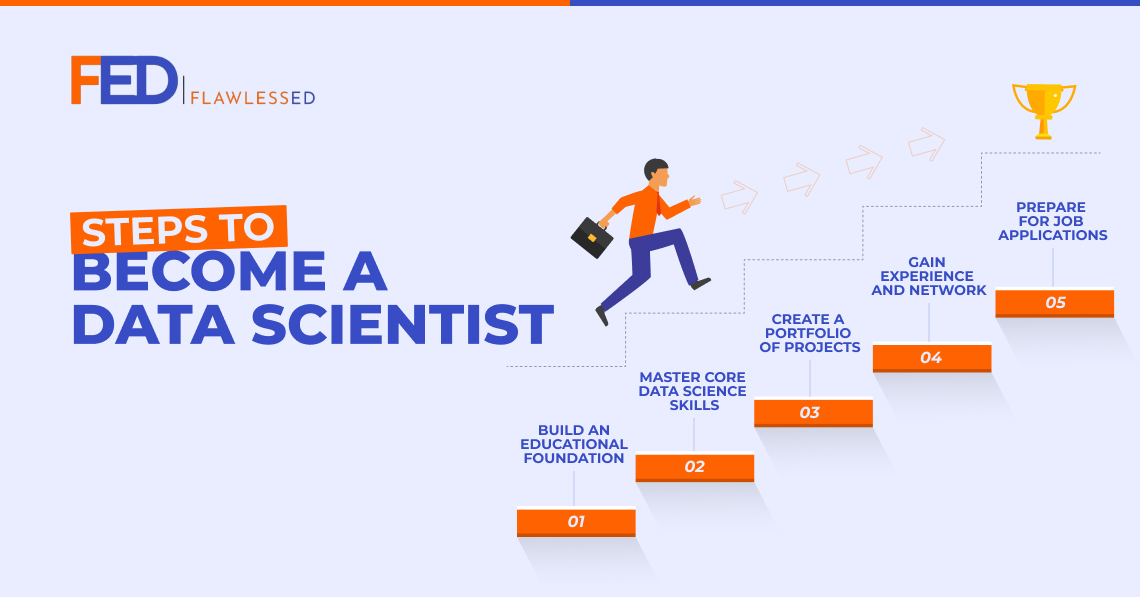
1. Build An Educational Foundation
You don’t always need a formal degree, but you do need the right basics.
The best way is to initially focus on very fundamental things, like statistics, basic maths, and programming. Please don’t stress yourself with becoming an expert in all these fields at the same time. Focus on learning step by step, especially concepts like probability, data handling, and logical thinking.
Also, begin with a programming language like Python, as it’s widely used in data science. The goal here is not to become perfect, but to build a basic knowledge so you understand what data is and how to work with it.
2. Master Core Data Science Skills
After finishing the basics, it is time to acquire methods, tools, and techniques that are applied in the field.
First of all, you need to learn what data analysts do, how they examine, clean, and interpret data. Then work with data visualization, that is showcasing insights through charts and dashboards. Lastly, understand fundamental machine learning as a means of creating predictive models.
Equip yourself with libraries such as Pandas and NumPy, as well as visualization tools like Power BI or Tableau. You should be able to take raw data and turn it into something useful and understandable.
3. Create A Portfolio Of Projects
Learning is important, but showing what you can do is even more important.
Start building small projects using real or sample datasets. For example, you might analyze data related to sales, do research on customer behavior, or make simple predictive models. The beauty of these projects is that they don’t have to be perfect. Their sole purpose is to depict your skills and dedication.
A strong portfolio helps recruiters see your skills in action. Moreover, you get to be more confident because, besides learning, you are actually implementing your knowledge.
4. Gain Experience And Network
To move closer to a job, you need some real-world exposure.
Start with internship, freelance work, or simply a small job done for a friend or a local business. Our main aim here is not to know the use of data through practice datasets, but to be able to see it through real situations. Besides, even a small amount of experience matters a lot for your resume.
At the same time, start building your network. Connect with people on LinkedIn, join communities, and follow others in the data field. Sometimes, chances are more likely to come from people you know rather than what you know.
5. Prepare For Job Applications
When you know how to do it and have done it a couple of times, the next thing is getting ready for the job market.
Design a simple resume that brings forward your competencies, the software you understand, and what you have been able to do through the projects. Don’t overdo it. Tell your story through your work. Also, prepare for interviews by practicing basic questions on data science, problem-solving, and explaining your projects clearly.
Don’t wait for the “perfect moment” to apply. Know for yourself that the moment is always now, you can always seek internships and entry-level jobs, and, of course, continue to work on upgrading your skills. By regularly applying and practicing, you would become more skilled and thus would have bigger chances of being hired.
How Can Flawless-ED Help You Become A Data Scientist?

Learning data science on your own can feel confusing. There is plenty of content on the web, and it is really difficult to figure out the sequence of learning, where to focus, and what is and isn’t suitable for landing a job.
That’s where Flawless-ED makes things easier. Instead of random learning, you get a clear path, structured lessons, and guidance on what skills to focus on. Besides the theoretical knowledge, you also get to implement your learnings, get familiar with the industry tools, and acquire the skills closely looked for by the companies.
If you’re serious about becoming a data scientist, the right guidance can save you a lot of time and effort. With the right support and practical learning approach, your journey becomes much clearer and achievable.
Final Thought
To become a data scientist in 2026, you do not have to be flawless on your very first day. It is more a question of starting gradually, being consistent all the way, and making progress one small step at a time.
It is totally fine to be clueless at the moment. That’s okay! What you can do is to get a strong foundation, do a good amount of exercises, and build a portfolio of projects. With time and effort, things start to make sense, and your confidence grows.
Catch you in the next blog with more updates on tech, skills, and learning paths you can explore, or maybe start learning with us at Flawless-Ed.
FAQs
Q- What qualifications do you need to become a data scientist?
A- You don’t always need a specific degree, but having a background in computer science, math, or statistics can help. More important is having the right skills, such as programming, data analysis, and problem-solving. Practical knowledge and projects matter more than just qualifications.
Q- How to become a data scientist in 2026?
A- Start with the basics like Python, statistics, and data handling. Then learn tools, build projects, and practice regularly. Follow a clear roadmap and keep improving step by step as you apply for internships or entry-level roles.
Q- Will data science be in demand in 2026?
A- Yes, data science will continue to be in high demand in 2026. Companies rely on data to make decisions, improve products, and understand customers. This keeps the need for skilled data professionals strong.
Q- How to become a data scientist roadmap?
A- A simple roadmap includes learning basics, building core skills, creating projects, gaining experience, and applying for jobs. You don’t need to rush; just follow each step consistently. With time, your skills and confidence will grow.
Q- Why become a data scientist?
A- Data science offers strong career growth, good salaries, and opportunities across industries. You get to solve real problems and work with meaningful data. It’s a good choice if you enjoy logic, analysis, and learning new things.
Q- How to learn Data Science?
A- Start with online courses or structured programs that cover basics to advanced topics. Practice with real datasets and build projects to apply what you learn. Learning becomes easier when you follow a clear path and stay consistent.